

Kevin Mertens: “In Ministry With People, Not For People”
For nearly twenty years, Kevin Mertens says, he “fought the call.”
Today, after completing the Deacons Formation Collaborative at Bexley Seabury Seminary, he is a newly ordained deacon at Trinity Episcopal Cathedral in Columbia, South Carolina.
The journey between those two moments was long, layered, and deeply shaped by service.
Before entering ministry full time, Kevin spent 35 years working in banking and securities on Wall Street. But the trajectory of his life shifted dramatically after September 11, 2001, when he lost more than two dozen colleagues in the attacks.
“That was the moment,” he reflected, “when I realized I couldn’t keep waiting.”
What followed was not an abrupt departure from ordinary life into seminary, but a gradual movement deeper into ministry within the life he was already living.
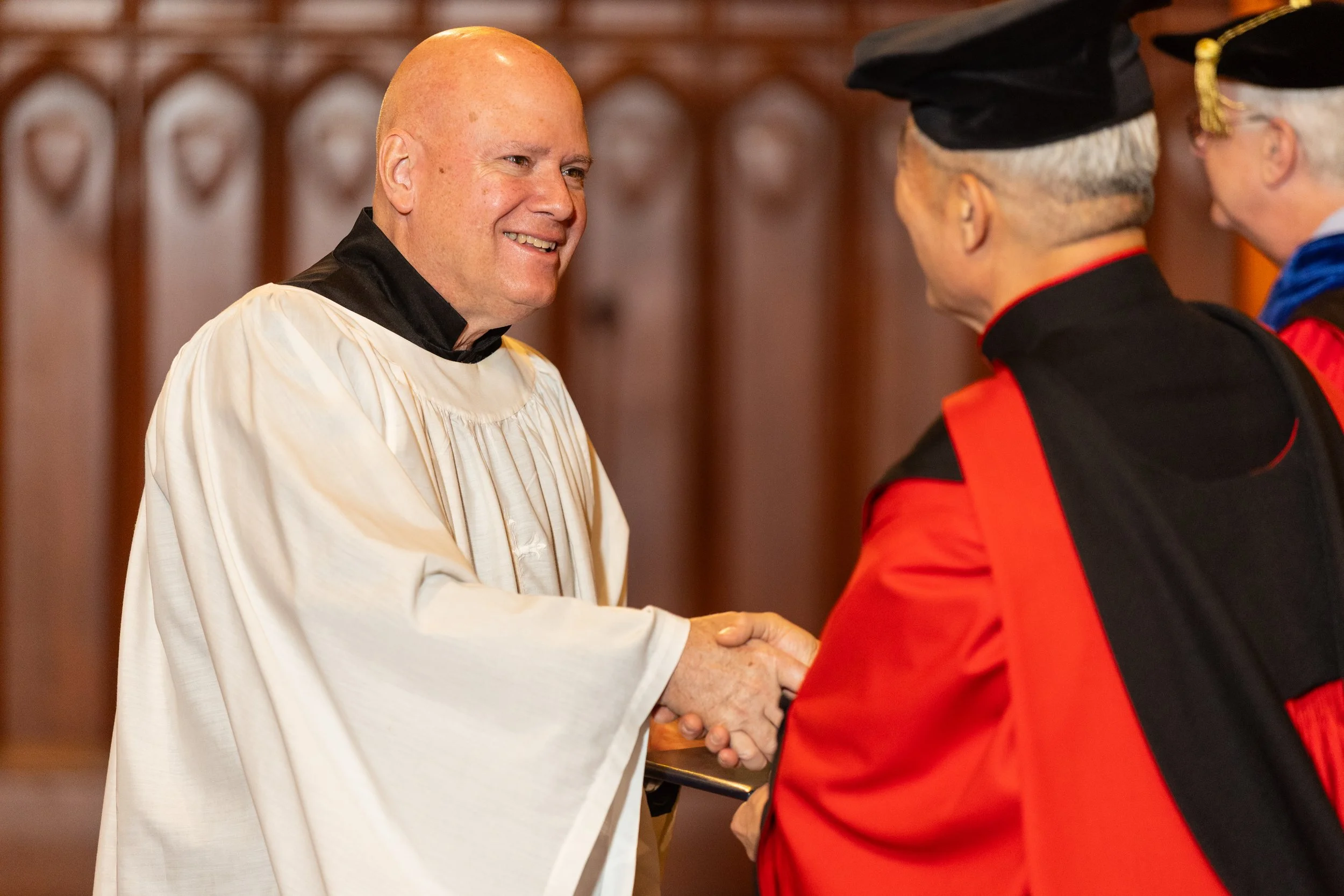
Kevin Mertens, Diocese of Upper South Carolina: “The deacon is called to be in ministry with people, not for people.”
Kevin became increasingly involved in outreach work through Christ Church in Greenville, South Carolina, eventually retiring from finance to focus full time on serving the community. Today, he leads ministries addressing food insecurity and housing instability, including collaborative efforts among churches to prevent evictions and advocate for fairer housing policies.
During the COVID-19 pandemic, Christ Church’s feeding ministry expanded dramatically — from serving approximately 10,000 parishioners annually to feeding more than 40,000 hungry neighbors.
And throughout all of it, the call to the diaconate persisted.
When the Diocese of Upper South Carolina selected Bexley Seabury’s Deacons Formation Collaborative as its pathway for formation, Kevin immediately recognized that the program’s mentor-assessed, flexible structure made something possible that traditional residential models could not.
He was able to continue his ministry, support his family, and remain rooted in his community while pursuing theological education.
“The old model often asked people to step away from their lives in order to prepare for ministry,” Kevin said. “But the DFC recognizes that people are already living deeply engaged lives of service and vocation.”
That integration became central to his formation.
Rather than treating outreach work as something separate from theological study, the DFC encouraged Kevin to bring real-world ministry directly into the learning process. Contextual placements, mentorship conversations, and coursework continually pushed him to ask not simply what he knew, but how that knowledge would help equip others for ministry.
His three mentors — including a diocesan archdeacon, a priest, and a national leader who helped write the Episcopal Church’s deacon competencies — challenged him to think beyond academics.
“How is this going to help you serve the least of these?” they repeatedly asked. “How is this going to help you equip parishioners for ministry?”
For Kevin, one sentence encountered during the program became transformative.
A priest and professor in London described the diaconate as being “in ministry with people instead of for people.”
“That was the drop-the-mic moment for me,” Kevin recalled.
The insight reshaped not only his understanding of the diaconate, but also his understanding of leadership itself.
“It’s not the deacon’s job to feed the poor,” he explained. “It’s the deacon’s job to provide opportunities for others to have transformative experiences feeding the poor.”
That vision also deepened through contextual placements in smaller congregations, where Kevin witnessed parishioners fully engaged in ministry rather than relying on large professional staffs.
“It was like in The Wizard of Oz,” he said. “When it suddenly goes from black and white to color.”
The mentor-based structure of the DFC also proved deeply formative in another way: sustainability.
Coming from the intense, goal-oriented culture of Wall Street, Kevin said his mentors consistently emphasized prayer, Sabbath, exercise, and boundaries — reminding him that ministry is “a marathon, not a sprint.”
For Kevin, the Deacons Formation Collaborative represents more than an innovative educational model. It represents a widening of access and possibility for the Church itself.
The flexibility of the program opens pathways for people who cannot relocate, leave careers, or uproot families in order to pursue formation. At the same time, the mentor-assisted and competency-based structure maintains rigor while grounding learning directly in ministry contexts.
“It allows the Church to form the people it is actually calling,” he said.
As he prepares for ordination and the next season of ministry, Kevin remains focused on the same work that has shaped much of his journey: fighting hunger, supporting housing stability, and helping equip others to live into their baptismal call to serve.
And for him, that work is inseparable from the heart of the diaconate itself: walking alongside people, listening for unmet needs, and helping the Church respond together.