

“This Was the Only Way”: Meet Andrew White ’26
On May 28, 2026, the Rev. Andrew White finished two journeys at once. That morning marked his final day as a full-time high school English teacher in Arkansas. A few weeks later, he would begin a new chapter as curate at St. John’s Episcopal Church in Fort Smith.
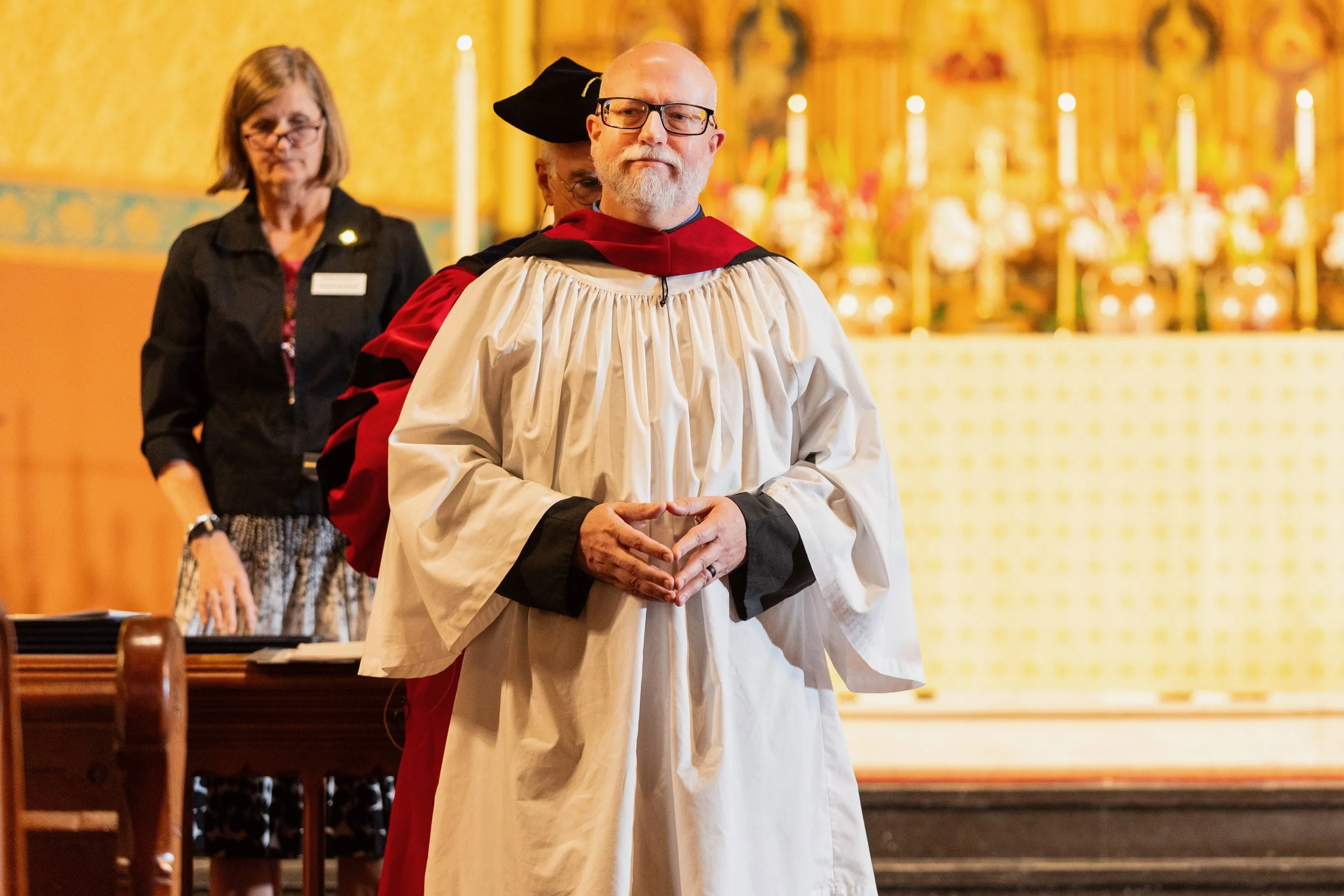
“I see people genuinely trying to be the face of Christ in the world,” says Andrew. “That gives me a lot of hope.”
At 53, after years of discernment, formation, teaching, and ministry preparation, Andrew is stepping fully into priestly ministry — without ever having uprooted his family, left his community, or abandoned the place where he felt called to serve. For Andrew, that mattered deeply. “I couldn’t have done residential seminary,” he says plainly. “There just wasn’t any way.”
When Andrew first began exploring ordination six or seven years ago, he was teaching full-time, rooted in northwest Arkansas, and supporting a family whose life and work were firmly planted there. Like many second-career discerners, he assumed his options would be limited. “I was glad to do a local Iona program if that’s what I needed to do,” he recalls. “But I’ve always loved academics, and I hoped there might be some way to experience actual seminary.”
That possibility emerged through Bexley Seabury. Encouraged by his bishop, the Rt. Rev. Benfield, Andrew applied to the seminary and received scholarship support that made pursuing an M.Div. possible through Bexley Seabury’s hybrid Beyond Walls model. “At that point, Bexley Seabury was really the only viable option,” he says. “And I’m deeply thankful it existed.”
Andrew’s story reflects one of the realities reshaping theological education today: many students discerning a call to ministry cannot simply leave careers, spouses, children, or communities behind in order to relocate for residential formation. Instead, they are already deeply embedded in the places where they are called to serve. For Andrew, remaining in Arkansas was not a limitation — it was part of the vocation itself.
A lifelong educator, Andrew spent years teaching Advanced Placement English and working closely with teenagers navigating questions of identity, purpose, and belonging. He also found himself increasingly drawn toward another group: people leaving evangelical churches while still longing for faith, community, and spiritual grounding.
“Being in Arkansas, a huge number of folks moving into the Episcopal Church are coming out of evangelicalism,” he explains. “Those are the people I feel especially connected with, partly because I’m an ex-evangelical too.”
When Andrew first entered the Episcopal Church, he says he immediately felt he had found home. “It wasn’t long after that that I started feeling called to ministry.”
Under the guidance of his parish priest, Andrew immersed himself in lay leadership and formation — serving as acolyte, lector, vestry member, and food pantry volunteer while simultaneously completing Education for Ministry (EfM).
One of the most formative experiences came through directing a parish food pantry. “We just took people exactly as they came,” he says. “We didn’t try to distinguish who deserved help and who didn’t.” That experience profoundly shaped his understanding of ministry and of the Episcopal Church’s baptismal promise to “seek and serve Christ in all persons.”
Another major turning point came through Clinical Pastoral Education (CPE) at a regional hospital, where Andrew discovered a surprising sense of vocation in some of the most difficult places imaginable. “I really loved being in the ICU and emergency settings,” he says. “For whatever reason, I felt drawn toward the really tough spots — being with people in those difficult moments.”
At Bexley Seabury, Andrew found a theological education that deepened and expanded those instincts. Courses in sacramental theology, Scripture, and ethics helped him think more deeply about what faithful Christian life looks like not only inside church walls, but in everyday human relationships and public life. He speaks especially warmly of New Testament and ethics professor Dr. Ajer, whose teaching opened Scripture in new and transformative ways. “He really changed the way I think about Christian vocation and how we love other people in the world,” Andrew says.
Just as significant was the community he encountered among fellow students. “I was incredibly impressed by my classmates,” he says. “The depth of thought, the nuance, the conversations — honestly, they were some of the smartest and most thoughtful people I’ve ever been around.”
As both an educator and a seminarian, Andrew also became a strong advocate for the possibilities of high-quality distance theological education. “We learned a lot after COVID about how to do this well,” he says. “The interaction, the depth of conversation, the faculty engagement — it was exceptional.”
In fact, he describes his seminary experience as comparing “very favorably” to his traditional undergraduate education. “The students wanted to be there,” he says. “The professors wanted to make it work. There was real investment on both sides.”
When Andrew first entered seminary, he assumed he would continue teaching full-time while eventually serving in part-time parish ministry. In Arkansas, most entry-level clergy positions are bivocational. Then something unexpected happened. A rare full-time curacy opened at St. John’s Episcopal Church in Fort Smith — the first such opening Andrew had seen in his region in nearly a decade. The position felt almost providential.
Located in downtown Fort Smith, St. John’s is deeply engaged in ministry with unhoused neighbors and vulnerable populations — work that aligns closely with Andrew’s own sense of calling. At the same time, the parish’s historic church building, traditional liturgical space, and long-standing community presence resonated deeply with his love for Anglican worship and sacramental life. “I never expected something like this would open up,” he says.
As Andrew prepares to begin ordained ministry full-time, he remains especially committed to the Episcopal Church’s witness of radical welcome and inclusion in a deeply conservative region.
“If you are LGBTQ in my hometown and want to go to church, the Episcopal Church is basically it,” he says. “A place where you can come exactly as you are and be welcomed at the Lord’s table without caveats.” Even amid political polarization and cultural anxiety, Andrew says he finds hope in local congregations and ordinary people quietly living out the promises of the Gospel.
“I see people genuinely trying to be the face of Christ in the world,” he says. “That gives me a lot of hope.” Looking back, Andrew is deeply aware that none of this would have been possible without the support of donors, scholarship funding, and the encouragement of his sending parish. “There’s no way this could have happened otherwise,” he says. “My M.Div. exists because people believed enough in this work to support students like me.”
Now, after years spent teaching, discerning, studying, and serving, Andrew is beginning the next chapter of ministry in the very region that first shaped his calling — carrying with him the conviction that theological education should meet people where they are, and prepare them to serve faithfully in the communities that already need them.