

From Uganda to Waltham: The Rev. William Kazibwe’s Journey to Priesthood
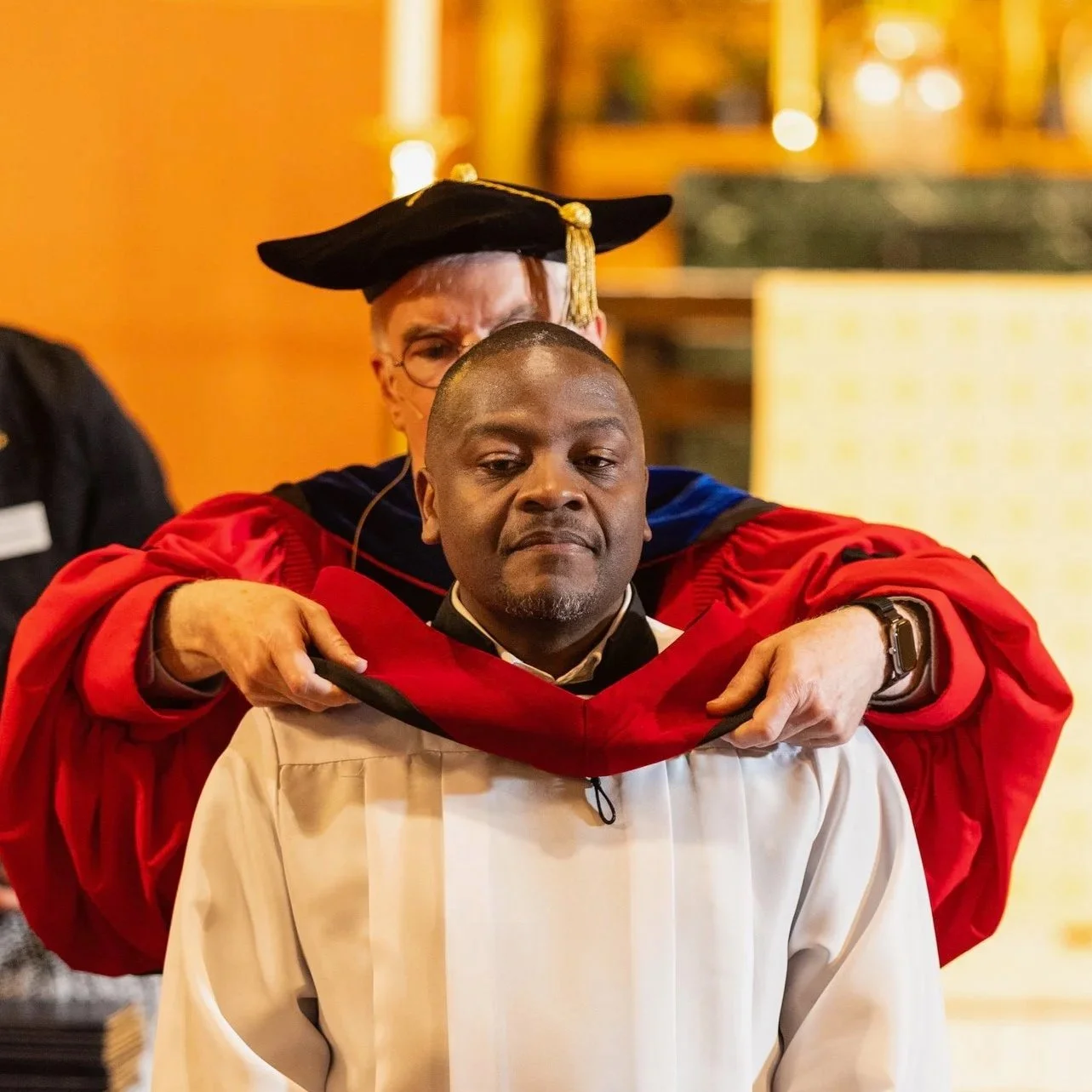
When the Rev. William Kazibwe ’26 was ordained in late May, he began his priestly ministry almost immediately.
“Coming to America, I was told this is the land of milk and honey,” said William. “I never imagined I would see a homeless person. I never imagined I would see an addicted person sleeping on the ground on a very cold day. That was a wake-up call for me.”
The very next day, he proclaimed the Gospel for the first time in two different churches — first at his field education site, and then at St. Peter’s in Waltham, Massachusetts, the immigrant congregation that had become his sending parish and spiritual home. For William, the moment carried the weight of a long journey: from Uganda to the United States, from lay leadership to ordained ministry, from nursing-home caregiving to seminary formation, and from a community in need of pastoral leadership to a call he could no longer ignore.
William grew up in the Anglican Church of Uganda. One of his grandfathers was a priest, and prayer, worship, and the Book of Common Prayer were woven into the rhythms of family and community life. “I grew up in church,” he says. “We used to lead prayers at home, at church, so I knew exactly what I was doing from the Luganda Book of Common Prayer.”
When William came to the United States in 2015, one of the first things he looked for was a church. At first, he found a nearby non-denominational congregation. The worship was lively and welcoming, but it did not feel like home. In a conversation with his grandfather back in Uganda, William learned something that changed the direction of his life. “My grandfather said, ‘I forgot to tell you — the Anglican Church in America is the Episcopal Church.’”
William searched online and found St. Paul’s Episcopal Church just a few blocks from where he was living in downtown Milwaukee. “I told him, ‘I found a church. It’s called St. Paul’s, and it’s an Episcopal church,’” William remembers. “And he said, ‘You’re in the right hands.’”
A few years later, life brought William and his family to Massachusetts. His wife was pregnant, and they needed access to health care. What was meant to be a temporary move became permanent when COVID lockdowns began. William found work as a Certified Nursing Aide and began caring for older adults in nursing homes during one of the most painful seasons of the pandemic. At the same time, he found St. Peter’s in Waltham — a Ugandan immigrant congregation and mission church of the Episcopal Diocese of Massachusetts that worships in space shared with Christ Church.
At St. Peter’s, William became a lay reader, helping lead worship, announce hymns, offer prayers, and support the liturgy. During COVID, when the congregation could not gather in person and had no priest, he helped lead online services. “We had a need,” he says. “Our church was losing membership. People became comfortable where they were, doing church online. But at least people could see each other’s faces and hear each other’s voices.”
His call to ordained ministry also deepened through his work in nursing homes. During COVID, family members and clergy often could not visit. Residents were isolated. Some were dying. “There was no one coming in,” William recalls. “People were dying. Saying a short prayer before this person leaves this place felt like the decent thing to do.”
Those prayers stayed with him.
At first, William imagined he might simply become a deacon. Financial pressures were real. He had a young family to care for, and his wife was also in school. But as his discernment continued, he began to see a fuller call to priesthood — a call rooted in pastoral care, immigrant ministry, and service to vulnerable communities. However, finding a seminary path was not easy.
William needed a program that would allow him to remain with his family, continue serving his community, and still receive serious theological formation. A diocesan leader sent him a list of hybrid programs, and Bexley Seabury stood out. A fellow member of the diocese, Faith Mbuthia, had studied there, and William trusted her guidance. “I just trusted her,” he says. “She took me through all the steps, and that is how I applied.”
Bexley Seabury’s Beyond Walls model gave William the pathway he needed. It did not make seminary easy. With young children, work, ministry, and family responsibilities, the sacrifices were significant. At one point, he and his wife made the difficult decision to send their children back to Uganda temporarily so both could complete their studies — he in seminary, she in nursing school. “It’s not that because it’s online, it’s easy,” William says. “You have to dedicate yourself. You have to be focused. It gives you leeway to do seminary in a comfortable place, but it doesn’t mean it’s easy.”
During his studies, William’s understanding of ministry expanded beyond the needs of his own congregation. His Clinical Pastoral Education placement with the Outdoor Church in Cambridge changed him profoundly. There, ministry took place not in a traditional church building, but on the streets with people who were unhoused. Volunteers offered food, helped with housing applications, identified warm places in cold weather, and gathered for prayer at shelters.
“Coming to America, I was told this is the land of milk and honey,” William says. “I never imagined I would see a homeless person. I never imagined I would see an addicted person sleeping on the ground on a very cold day. That was a wake-up call for me.” The experience challenged his assumptions and deepened his compassion. “Their life is not different from my life,” he says. “It is just a small mistake in life that can turn things around. Some of these people don’t have family. Their stories are not different from my story, or any other person’s story.”
Formation at Bexley Seabury also helped William imagine new possibilities for immigrant ministry and church planting. In a course on church planting, guest speakers who had started ministries among African and Asian immigrant communities inspired him to think more broadly about how churches can serve people navigating displacement, cultural transition, and spiritual belonging.
As he looks ahead, William hopes to help St. Peter’s become more deeply felt in the wider Waltham community. “Our church is not growing,” he says. “It’s stagnant. Some come, but they don’t stay.” His hope is not simply that people will know St. Peter’s exists, but that they will experience its presence through service. “Being felt as a church is the most important thing,” William says. “People may know you, but what are your deeds? What are the fruits that you bear?”
He imagines a church that opens its doors to neighbors who are hungry, cold, unhoused, newly arrived, or in need of community. “We have so many homeless people here in Waltham,” he says. “We have so many immigrants who are struggling with different things. If we open up our doors to this community and say, ‘We have soup for you. We have clothes for you. If you’re cold, you can use our basement’ — that is what I want us to be.”
William is also beginning curacy work in Natick, where one of the outreach ministries includes a nursing home where he once worked as a CNA. For him, the connection feels providential. “I was excited when I saw it on the list,” he says. “This could be a good thing for me.”
Looking back, William is deeply grateful for the people whose generosity helped make his formation possible. Financial aid, grants, and book support from the Church Club mattered more than he can easily express. “You just wake up one morning, and you get this notification that financial aid has come in,” he says. “That is very good support. I don’t have the words to thank them.”
Now ordained, William hopes to carry that generosity forward. “If I’ve been helped, I would like to push it over to the next people,” he says. “However small it might be, it normally adds up.”
From Uganda to Milwaukee, from Milwaukee to Massachusetts, from lay reader to priest, William’s journey has been shaped by migration, caregiving, family sacrifice, and the steady call to serve. And now, as he begins ordained ministry, his hope is simple and strong: that the Church will be present, open, and felt in the lives of the people who need it most.