

Rooted in Community, Formed for Ministry: Meet the Rev. Quincy Hall ’26
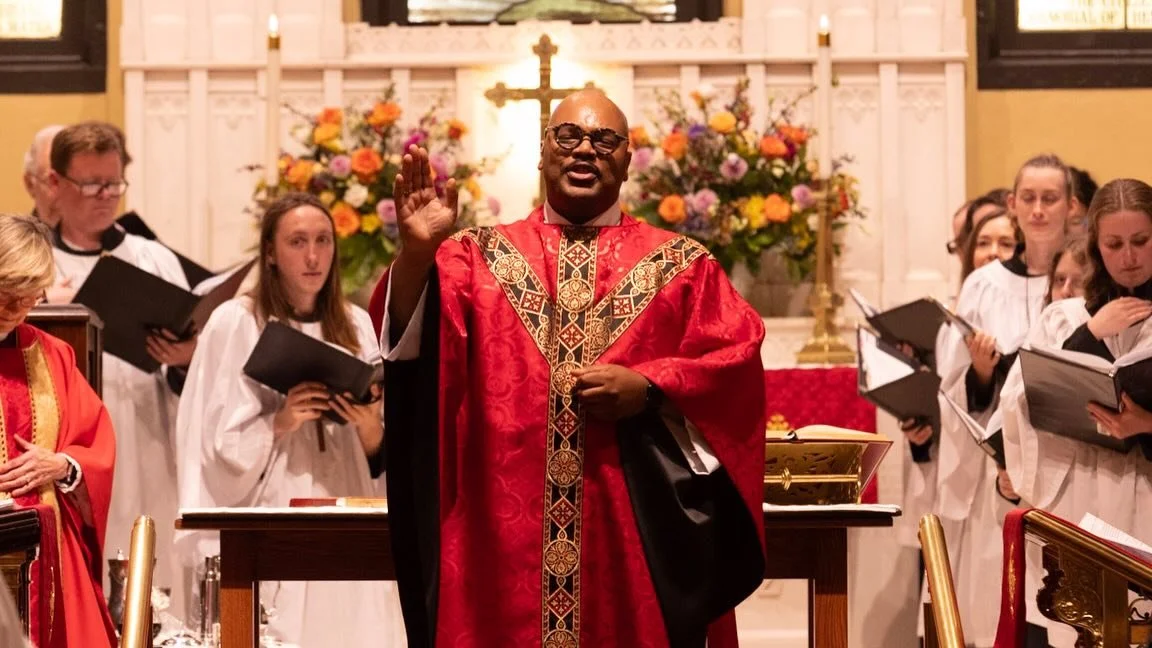
“Bexley Seabury makes seminary possible for people from many walks of life,” Quincy says. “It allows people to be where they need to be while still receiving intentional, meaningful formation.”
Before seminary, the Rev. Quincy Hall ’26 imagined his future in higher education.
A trained therapist working at the University of Alabama, Quincy found joy in helping students discover who they were, what mattered to them, and how their gifts might serve the world. He envisioned pursuing a PhD and building a life in the academy — perhaps eventually serving as faculty or in student leadership.
At the same time, people around him kept noticing something else.
Friends and mentors in his parish and throughout the Diocese of Alabama would often tell him: “You would make a wonderful priest.”
“At first, I resisted it,” Quincy recalls with a laugh. “I already had my plan.”
That changed during a Cursillo retreat, when one of the spiritual directors took his hands and told him simply: “You have the Spirit about you.”
The moment stayed with him.
“I wasn’t even thinking about discernment at that point,” he says. “But by the end of that conversation, I knew I needed to enter the process.”
As Quincy discerned a call to ordained ministry, he also knew he needed a form of theological education that would allow him to remain rooted in his community and continue working while preparing for ministry.
That search eventually led him to Bexley Seabury.
“The program just felt like a perfect fit for my context and my situation,” he says. “The hybrid model, the intensives, the M.Div. program, the people — it all felt very intentional and adaptable.”
For Quincy, one of the most formative aspects of Bexley Seabury’s Beyond Walls approach was the opportunity to remain deeply connected to real ministry contexts throughout his formation.
“You weren’t removed from the world while you were learning,” he explains. “You were constantly evaluating what ministry actually looks like in different contexts and communities.”
That experience expanded his understanding of both ministry and the Church.
Travel courses such as Learning from London and Learning from Alabama exposed Quincy and his classmates to creative and community-centered forms of ministry. In London, he encountered clergy reimagining parish spaces as neighborhood gathering places and community hubs. During one memorable experience, a local priest led students on a prayer walk through the surrounding neighborhood, inviting them to reflect on the people, struggles, and realities present around them.
“It changed the way I think about community and about who our neighbors really are,” Quincy says. “It challenged me to think outside the box about what it means to be the Church.”
Over time, seminary also clarified something deeply personal.
Although Quincy had long felt drawn both to the academy and the Church, his experiences in parish ministry made one thing increasingly clear: this was where he felt most alive.
“I realized that ministry grounded me in who I am,” he says. “I knew this was where I was meant to be.”
Today, Quincy serves as priest-in-charge of two parishes in the Diocese of Alabama.
One is a small-town campus parish shaped by the rhythms and challenges of university life. The other is a historic Black parish in Birmingham’s Titusville neighborhood, where demographic changes and community needs are creating new opportunities for partnership and outreach.
Rather than approaching ministry as something the church does for a community, Quincy hopes to cultivate collaboration and shared leadership with the people already there.
“How do we bring the community into the work?” he asks. “How do we listen first? How do we partner instead of assuming we already know what people need?”
That posture of servant leadership is something he traces directly to his seminary formation.
“Bexley Seabury helped me think differently about ministry,” he says. “Not just doing the same old, same old — but asking how we can respond faithfully and creatively to the realities people are living right now.”
That work is not always easy.
As a Black and gay priest serving in Alabama, Quincy speaks honestly about the challenges of ministry in a complicated political and social climate. Yet he also speaks with deep hope — hope grounded not in abstraction, but in relationships, community, and the quiet daily work of building trust.
“I see God moving in the ordinary moments,” he says. “When you stay rooted in people and community, you begin to see bridges being built.”
For Quincy, Bexley Seabury provided more than an education. It provided a pathway — one that allowed him to remain connected to home while preparing for a wider and evolving ministry.
“Bexley Seabury makes seminary possible for people from many walks of life,” he says. “It allows people to be where they need to be while still receiving intentional, meaningful formation.”
Now only months into ordained ministry, Quincy is already helping lead communities through change, imagining new possibilities for partnership and mission, and discovering the joy of serving exactly where he is called to be.
“I haven’t lost my sense of self,” he says. “I know who I am. I know where I’m meant to be.”