

Forming a Diaconate of the Whole Church
Formation does not belong to seminaries alone.
It is the shared work of the Church.
By the Rev. Hailey McKeefry Delmas
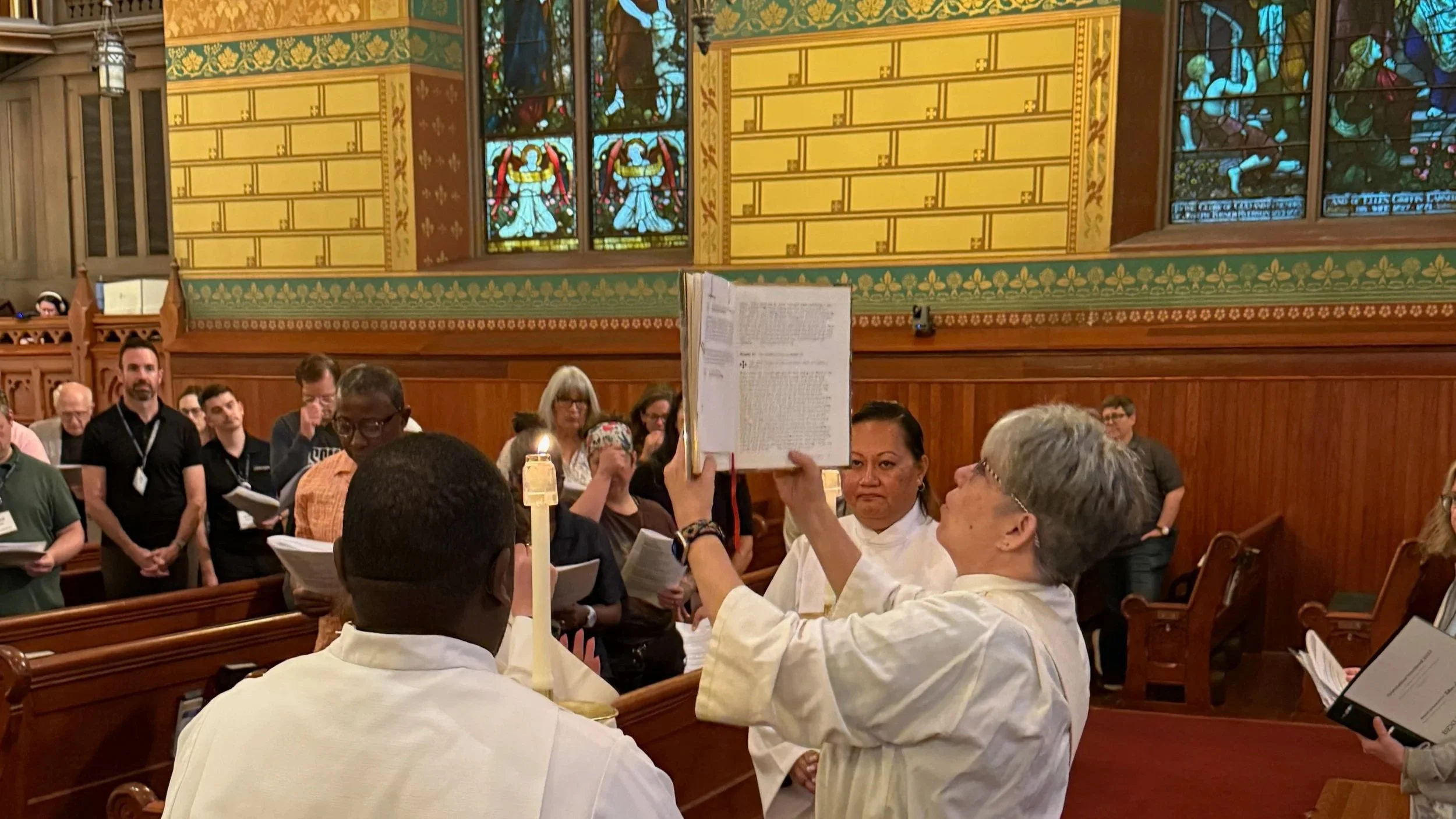
The Rev. Hailey McKeefry Delmas proclaims the gospel during a Bexley Seabury service at St. James Cathedral in Chicago.
What does it take to form a deacon?
The answer cannot simply be coursework. Scripture, theology, Church history, pastoral care, and the other disciplines of theological education matter deeply. But formation for ministry asks something more. It requires opportunities to connect what we learn with who we are becoming and with the communities in which we are called to serve.
And that kind of formation cannot happen alone.
At Bexley Seabury Seminary, we often talk about being a Seminary Beyond Walls. For me, that means more than delivering theological education across geographic boundaries. It means recognizing that some of the most important formation happens within relationships—among students, faculty, dioceses, congregations, communities, and experienced ministers willing to walk alongside someone who is still discovering what their vocation will ask of them.
We see this particularly clearly in the Deacons Formation Collaborative (DFC).
The DFC currently brings together deacon postulants from more than two dozen dioceses. Because students remain rooted in their own communities while learning alongside people from other contexts, they encounter something larger than any one diocese's understanding of the diaconate. Together, they begin to see the many forms diaconal ministry is taking across The Episcopal Church.
Mentorship is an essential part of that formation.
Each DFC student is accompanied by a team of three mentors who bring different perspectives to the student's journey: one who knows the student personally and vocationally, one who understands the student's diocesan context, and one who helps connect the student to the academic and formational work of the DFC.
Their role is not simply to make sure assignments get completed or requirements are met. Mentors help students make connections between learning and vocation. Again and again, we ask students questions such as: Why is this relevant to you as a deacon? Where do you see this in the community you serve? How might what you are learning shape the way you respond?
Those questions can be asked about Scripture, history, theology, pastoral care, advocacy, or almost anything else we study. They are questions that move education beyond acquiring knowledge and toward formation.
And something unexpected happens in the process: the mentor is formed, too.
As our first DFC students have completed the program, we have heard about deep relationships that developed between students and mentors. Students describe the gift of being accompanied by people whose lived wisdom helps them understand their own emerging ministries. Mentors tell us that walking alongside a student has caused them to think more deeply about diaconal ministry, revisit their own formation, and see their vocation through new eyes.
Perhaps that shouldn't surprise us.
Christian formation has always been relational. We learn through teachers and communities, certainly, but also through the people who ask us difficult questions, recognize gifts we cannot yet see in ourselves, challenge our assumptions, and remind us why we answered God's call in the first place.
This is particularly important for a Seminary Beyond Walls. When theological education is rooted in the places where students already live and serve, the Church itself becomes part of the learning environment. Formation is not confined to a classroom or campus. It takes shape in congregations, dioceses, neighborhoods, ministries, workplaces, and relationships.
That means the formation of the Church's future leaders belongs, in some measure, to all of us.
There are more than 3,000 vocational deacons serving across The Episcopal Church, according to the Association for Episcopal Deacons. The DFC currently has approximately 110 mentors. Many who have accompanied one student have chosen to accompany another.
That tells me something important. Mentoring is not simply a service we provide to someone else. It is an opportunity to participate in the ongoing formation of the diaconate—and perhaps to rediscover something about our own calling along the way.
So, I would like to extend an invitation, particularly to experienced deacons: Who helped form you? What wisdom did someone entrust to you that should now be entrusted to someone else?
If you have at least five years of experience as a deacon and a desire to accompany someone preparing for this ministry, I invite you to consider becoming a DFC mentor.
The Church already holds an extraordinary wealth of wisdom about diaconal ministry. The question is how we share it with those who will carry that ministry forward.
Reach out and let’s explore whether you are called to be one of our mentors. To schedule a meeting with me, please click the link HERE to go to my booking page.