

Meeting People Where They Are: How the Deacons Formation Collaborative is Reshaping Formation
By the Rev. Hailey McKeefry Delmas
As the first students of the Deacons Formation Collaborative graduate, the Rev. Hailey McKeefry Delmas, Director of the Deacons Formation Collaborative and Educational Technologist reflects on why flexible, mentor-guided formation matters for the future of the Church.
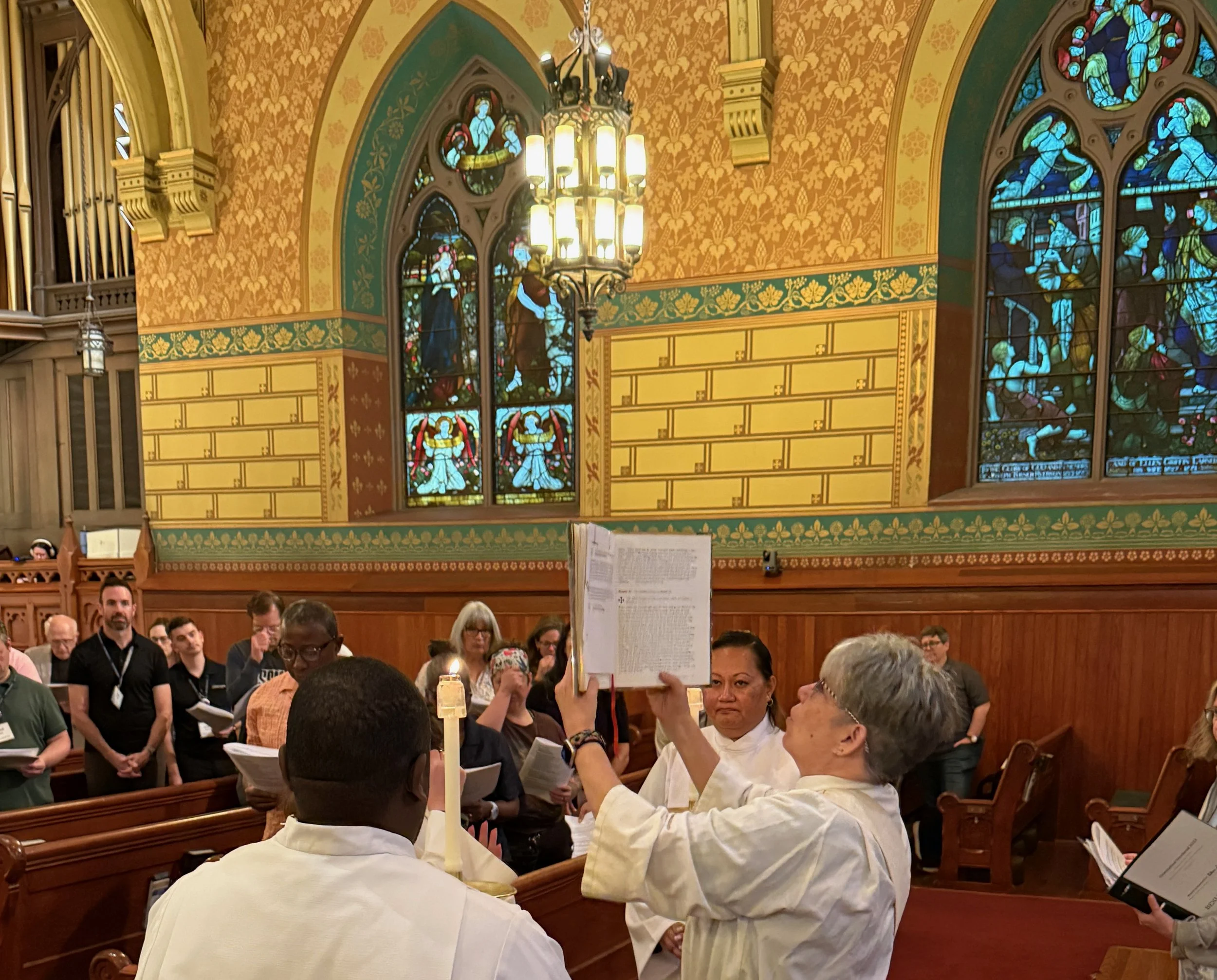
The Rev. Hailey McKeefry Delmas proclaims the gospel during a Bexley Seabury service at St. James Cathedral in Chicago.
I get to talk to aspiring deacons every day. They are diverse and gifted individuals. They have that in common. They have something else in common: Almost without exception they have been running from God’s voice for years. When I talk to formation leaders, I hear another clear point of agreement: The Episcopal Church – and the world – needs more deacons. Clearly, we are dealing with a big gap, and, I believe, the way we have historically approached diaconal formation is part of that gap.
The whole thing started from a really good and respectful place. We all agreed that the diaconate is a full and equal order with priesthood. Therefore, we reasoned, deacons need fulsome and robust formation. We do that with priests and so let’s make sure that deacons get a comparable education. That makes sense! Except it’s a little like saying: ‘I fit in my pajamas, and my pajamas fit in my suitcase, therefore I fit in my suitcase.” The way we form priests inherently doesn’t fit deacons.
Why? Well, priests are being formed for a job that is often full-time and compensated. For them, leaving their current lives and going to a three-year residential seminary program or starting a full-time education online makes some sense. They want to get formed and get started. Deacons meanwhile are not paid and often are retired or working in a full-time secular career in addition to ministry. Deacons need a program that is flexible and not time limited. That’s why the Deacons Formation Collaborative (DFC) has been designed to be asynchronous and readily done in four to six hours a week.
Further, the work of deacons is highly variable—some are chaplains, some lead parish outreach efforts, some help plan and manage feeding or housing programs, some are leading the charge in public resistance to injustice. If you have met one deacon, you have met one deacon.... There are many models of ministry. That’s why we designed an eight-path program that leverages a diaconal lens and is based on the Competencies for Deacons created by the Association of Episcopal Deacons (AED) to conform to the Canons of the Church. We also allow students to modify the work to address the realities of their particular context.
However, learning is best done in the company of others. Each of our students has a team of three mentors who walks with them and encouragesthem. We have regular student gatherings (online) to work together. In addition, the AED and the DFC co-sponsor a weekly meeting for deacons across the church titled Deacons Talking on the Road to Emmaus that offers opportunities for worship, reflection, storytelling and continuing education. Nobody is alone.
Why don’t we have enough deacons? Why do deacons run from God’s call? Sometimes it’s because formation has been impossible. As we welcome the first four recipients of the Diploma in Diaconal Studies into the Bexley Seabury Seminary alumni community, we are seeing what becomes possible when formation adapts to the realities of people’s lives. The DFC is helping shift the model so that all those with the heart of a deacon are able to answer the call.
Formation that adapts to real lives is producing deeply prepared leaders already serving the Church and world.