

This spring, four students became the first graduates of Bexley Seabury Seminary’s Deacons Formation Collaborative.
Pam Archbold, Kevin Mertens, Amanda Wright, and Mel Foresman received their Diplomas in Diaconal Studies during Commencement and Holy Eucharist in Chicago, marking a significant milestone for both the graduates and the innovative formation model that brought them there.
When these first graduates crossed the stage, they marked more than a program milestone. They became the first visible fruits of a new model of formation — one designed for people whose calls to ministry are already taking shape in the midst of full lives, local communities, family responsibilities, parish leadership, professional work, and service to neighbors in need.
Pam, Kevin, Amanda, and Mel entered the Deacons Formation Collaborative from different dioceses, different life stages, and different ministry contexts. Their stories are distinct. But together they reveal something essential about the DFC: formation does not need to remove people from the places where God is already at work in their lives.
It can meet them there.
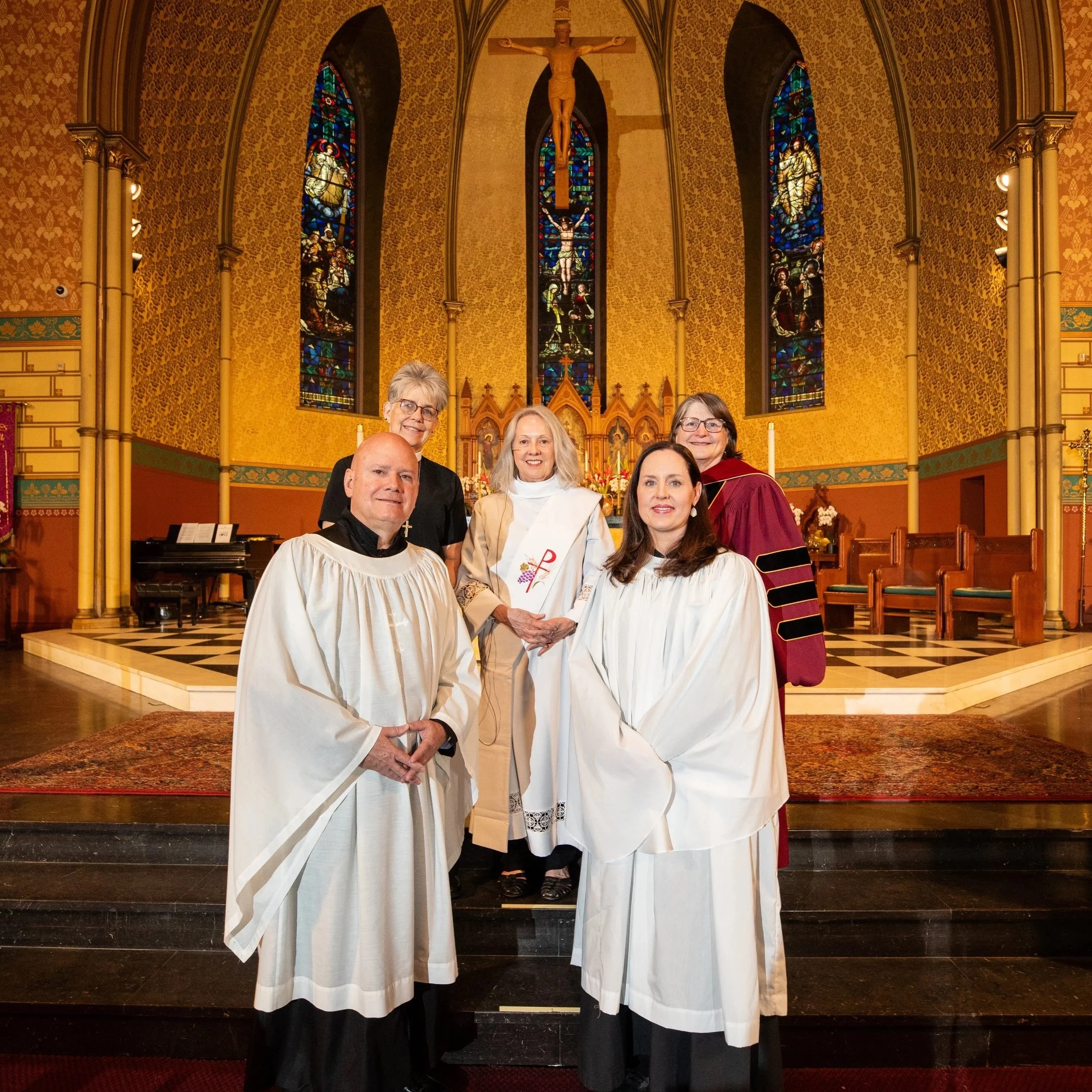
Members of the first graduating cohort of Bexley Seabury Seminary’s Deacons Formation Collaborative following Commencement at St. James Cathedral, Chicago. (clockwise) DFC Director the Rev. Hailey McKeefry Delmas. Pam Archbold, Dr. Julie Lytle, Director of Distributive and Lifelong Amanda Wright, and Kevin Mertens, Mel Foresman, the fourth graduate of the cohort, received her Diploma in Diaconal Studies in absentia.
For Pam Archbold, a hospice nurse now serving as a deacon at St. Luke’s Episcopal Church in Park City, Utah, the DFC made it possible to integrate formation with a life already shaped by pastoral care. Her ministry includes parish worship, hospital chaplaincy, interfaith collaboration, and care for aging and vulnerable neighbors. Rather than stepping away from that work in order to study, Pam found that her ministry and formation continually deepened one another.
The old model often asked people to step away from their lives in order to prepare for ministry. The DFC is built around the reality that many people called to the diaconate are already living deeply rooted lives of service and vocation. For Pam, that meant discovering that her work, family life, and community commitments were not obstacles to formation. They were part of it.
Kevin Mertens came to the DFC after a long career in banking and securities and years of ministry focused on hunger and housing stability. At Christ Church in Greenville, South Carolina, he helps lead outreach addressing food insecurity and eviction prevention. During the COVID-19 pandemic, the parish’s feeding ministry expanded dramatically to meet urgent community need.
For Kevin, the program helped clarify the deacon’s vocation not as doing ministry on behalf of others, but as equipping the whole Church for ministry. One insight from the program became a defining phrase for him: deacons are called to be “in ministry with people, not for people.”
That shift changed the way he understood leadership. “It’s not the deacon’s job to feed the poor,” he reflected. “It’s the deacon’s job to provide opportunities for others to have transformative experiences feeding the poor.”
Amanda Wright’s path began through mission and outreach at Church of the Holy Spirit in Lake Forest, Illinois. After growing up Catholic, she joined the Episcopal Church with her family and discovered a community that did not simply support neighbors from a distance, but built relationships through service.
Over time, Amanda became deeply involved in parish leadership, eventually chairing Mission and Outreach. Through that work, others began naming what she had not yet fully claimed: “You’re already being a deacon.”
The DFC gave Amanda a way to pursue formation while continuing her life as a physical therapist, parent, and parish leader. It also helped her see that diaconal ministry is not about leading every ministry herself. It is about helping others discern their own gifts and answer their own calls to serve.
That insight has already shaped her ministry. During the DFC, Amanda began a prison ministry in Waukegan, Illinois. She arrived with a curriculum, but soon discovered that the people gathering did not need an abstract program. They needed church: communion, prayer, Scripture, conversation, and a place where they could be heard.
“I had to change my plan to meet their needs,” she said.
Mel Foresman’s story carries another thread: a call that waited patiently.
After retiring from teaching in the Pacific Northwest, Mel found that a sense of vocation she had carried for nearly thirty years returned with renewed urgency. Traditional formation models did not fit easily with the life and relationships she had already built. What she found in the DFC was not only flexibility, but what she described as a “humane” approach to formation.
For Mel, that meant being seen as a whole person — someone with a history, a family, a community, and ministry already underway. Her work with people experiencing homelessness and economic instability through Hope and Bread Mission Church in Portland became part of her formation, not separate from it.
Across all four stories, mentorship emerges as one of the defining strengths of the DFC. Students are supported by mentor teams who help them connect learning with practice, vocation with context, and spiritual formation with sustainable ministry.
The program is flexible and largely online, but its graduates describe it as deeply relational. They speak of mentors, peer connections, diocesan partners, and wider networks of deacons across the Church. The relationships formed during the program do not end at graduation. They continue as part of the support system these new deacons carry into ministry.
Together, these first graduates show what becomes possible when formation is rigorous, contextual, relational, and accessible.
They are serving in parishes, hospitals, interfaith councils, outreach ministries, prison ministry, food and housing advocacy, and communities facing poverty, isolation, illness, and instability. Their formation did not pull them away from those places. It helped them recognize more clearly how God was already calling them within those places.
The Deacons Formation Collaborative is still young, but its first graduates already point toward a future Bexley Seabury is committed to building: a network of formation pathways that meet people where they are and prepare them to serve where the Church is most needed.
Pam, Kevin, Amanda, and Mel are not simply the first graduates of a new program.
They are signs of what formation beyond walls can make possible.
Learn More
Read the Rev. Hailey McKeefry Delmas’s reflection on the development of the Deacons Formation Collaborative:
Meeting People Where They Are: How the Deacons Formation Collaborative Is Reshaping Formation
Meet the graduates: