

For nearly thirty years, Mel Foresman carried a sense of call she could never quite leave behind. Life moved forward. She taught school, built a life in the Pacific Northwest, and eventually retired from teaching. Along the way came marriage, parish involvement, community relationships, and the ordinary rhythms and responsibilities that shape a person over decades.
But the call remained. “It came back in a big hurry,” Mel reflected with a laugh, remembering the season after retirement when the possibility of ordained ministry returned with unmistakable clarity. Even then, however, the path forward was not immediately obvious.
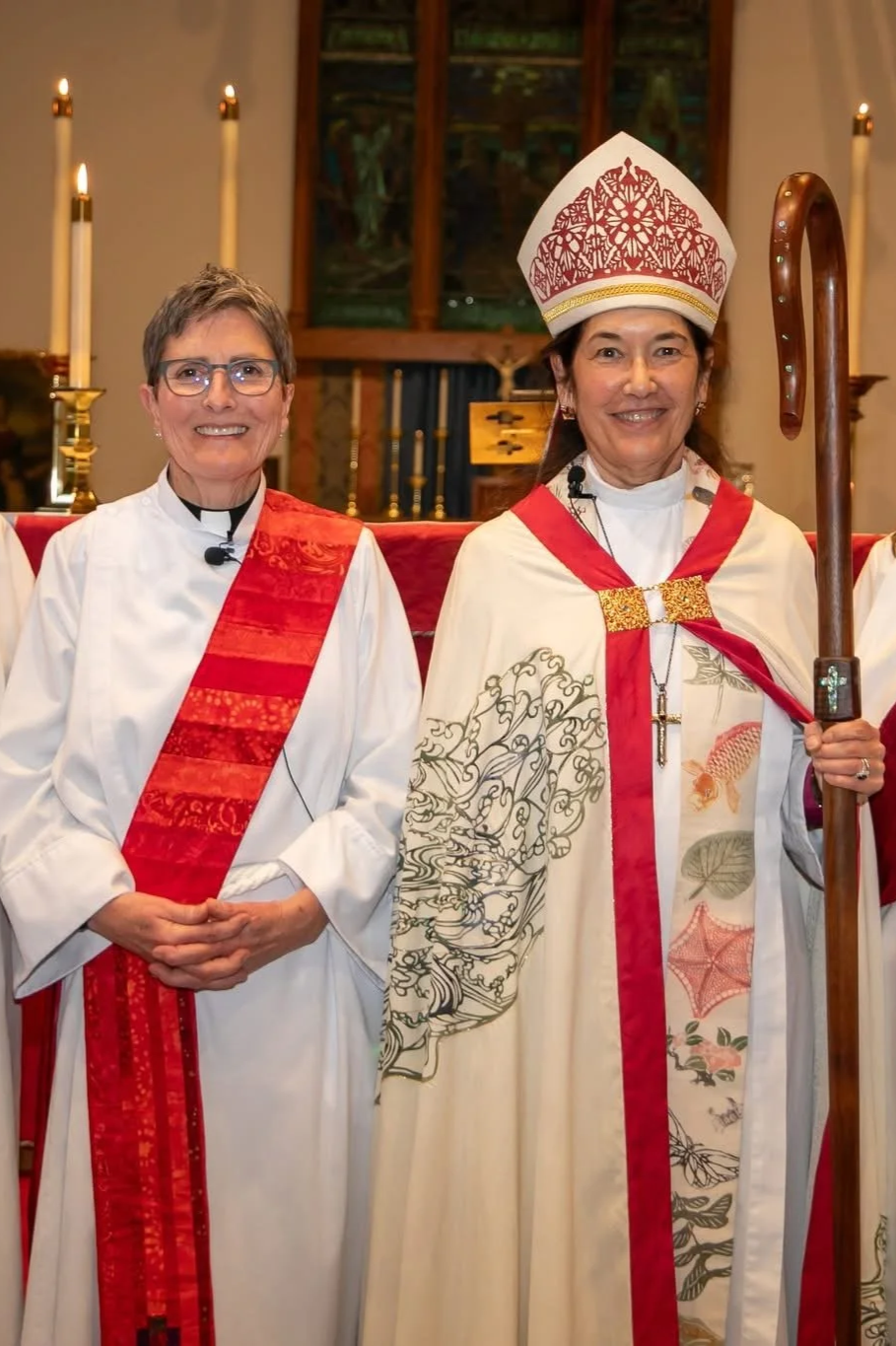
Mel Foresman (l) at her ordination with Bishop Akiyama in the Diocese of Western Oregon. “It felt like the program understood who we already were,”
Like many called to the diaconate later in life, Mel quickly recognized that traditional models of formation did not align easily with her circumstances. Residential seminary education — uprooting one’s life, relocating, or stepping away from existing commitments — simply did not make sense for someone already deeply rooted in community and ministry.
What eventually drew her to Bexley Seabury Seminary’s Deacons Formation Collaborative was not simply flexibility, but something deeper. Again and again during conversation, Mel returned to one particular word to describe her experience of the program:
“Humane.”
For Mel, that meant more than convenience or scheduling. It meant formation that recognized students as whole people — people with families, relationships, work histories, local ministries, emotional lives, and long vocational journeys already underway. Rather than asking students to leave those realities behind, the DFC invited them to bring their full lives into the process of formation. “It felt like the program understood who we already were,” she said.
That integration became especially meaningful because Mel’s formation was never purely academic. Throughout the program, what she studied continually intersected with ministry she was already living out in real communities.
One of the defining threads of her ministry has been accompanying people experiencing homelessness and economic instability through Hope and Bread Mission Church in Portland, Oregon. What began as volunteer service gradually deepened into a vocational center of gravity — one that continued alongside her coursework and contextual formation. “The threads were already there,” she reflected. “The program helped me recognize them.” Just as important was the relational dimension of formation.
Although the DFC is geographically dispersed and primarily online, Mel speaks passionately about the importance of community and personal connection within the process. Mentors, fellow students, and diocesan leaders became companions along the journey rather than distant academic contacts.
She acknowledges that online formation requires intentionality and creativity to foster deep relationships, but rejects the idea that meaningful community cannot emerge in digital spaces.
“The relationships are real,” she said simply.
That sense of connection became particularly powerful during commencement season in 2026, when the first graduating cohort of the Deacons Formation Collaborative gathered to celebrate a milestone years in the making. Although Mel was unable to attend commencement in person and received her Diploma in Diaconal Studies in absentia, she remained deeply connected to the cohort community through online gatherings and shared formation experiences.
Now ordained to the diaconate, Mel plans to remain active in the parish and ministry contexts that shaped her discernment from the beginning. Rather than seeing ordination as the start of an entirely new chapter, she describes it as a continuation and deepening of long-standing commitments to service, accompaniment, and community.
For Mel, that continuity may be one of the most important lessons of the DFC itself. Formation, she believes, does not begin when someone enters seminary. Often, God has already been quietly at work through years of ordinary life, relationships, service, and longing.
Programs like the Deacons Formation Collaborative, she said, make it possible for the Church to recognize and nurture those vocations more faithfully — especially for people whose lives do not fit traditional educational models. And perhaps most importantly, they remind people that no one answers a call alone. “The support matters,” Mel reflected. “The community matters.”
Even now, after graduation and ordination, those relationships continue.